复杂系统人因与工效学研究所
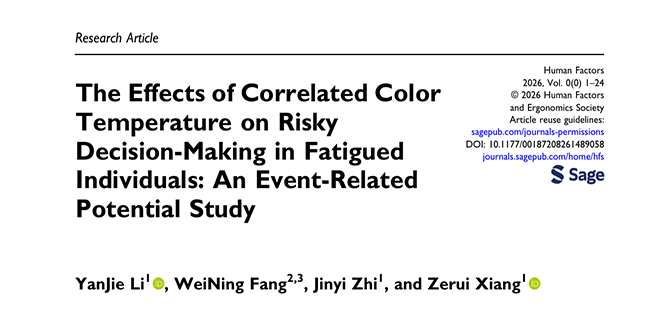
Objective: This study investigated the effects of correlated color temperature (CCT) on risky decision-making in fatigued individuals and the potential neural mechanisms underlying these effects.Background:Underground facilities (UGFs) are increasingly utilized as military shelters, but the environmental stressors within them can easily lead to mental fatigue among commanders. The blue component within polychromatic white light, as indexed by CCT, has been shown to enhance alertness and cognition through non-visual pathways mediated by intrinsically photosensitive retinal ganglion cells (ipRGCs). However, it remains unclear whether CCT can benefit risky decision-making in fatigued individuals during the day.
Method: We examined the effects of varying CCTs (4000 K, 6500 K, 8500 K, 12,000 K) on fatigued individuals using a within-subjects design (N = 21) and assessed subjective alertness and mood, behavioral performance in attention and risky decision-making, and event-related potentials (ERP), including feedback-related negativity (FRN) and the P300 component.
Results: The results showed that 12,000 K led to more favorable decisions, reflected by a lower risk ratio, more cash-outs, and higher revenue. ERP analyses revealed larger FRN and P300 amplitudes under 12,000 K, indicating that higher CCT enhanced cognitive control and promoted more conservative decision-making, enabling beneficial feedback-based decisions even under fatigue.
Conclusion: Blue-enriched white light improves alertness, mood, and decision-making in fatigued individuals, promoting gain-maximizing and risk-minimizing decisions.
YanJie Li, WeiNing Fang*,Jinyi Zhi, Zerui Xiang.The Effects of Correlated ColorTemperature on RiskyDecision-Making in FatiguedIndividuals: An Event-RelatedPotential Study.Human Factors
2026,DOI: 10.1177/00187208261489058